Version v1.2 is available as a free update to everyone.
A new version of our color grades is live, and here’s exactly what changed. Capture One .icc profiles now come…
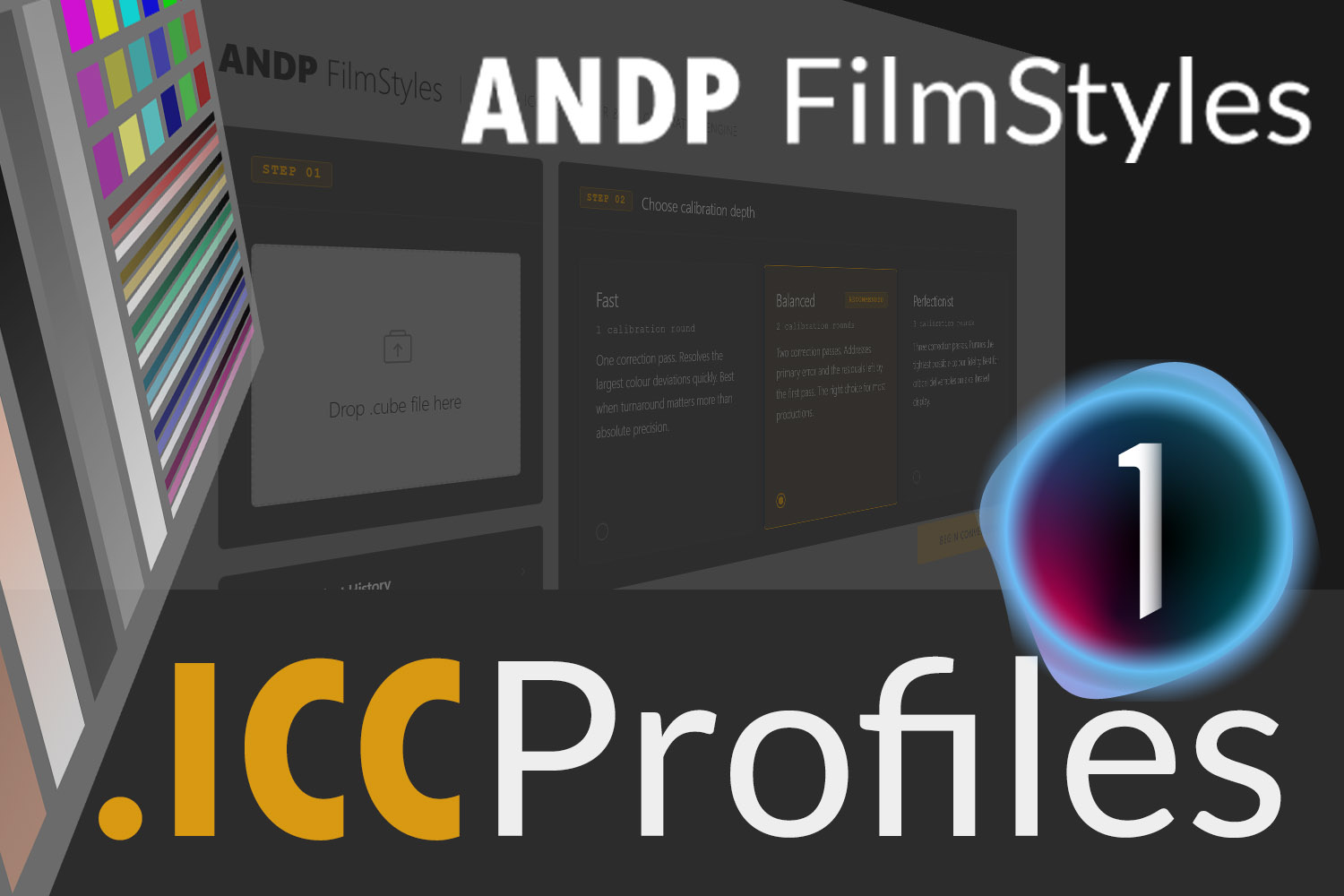
Hello FilmStylers!
I am happy to announce that alongside our website’s overhaul, Capture One support has now gone live and all of our products have received this upgrade for free! All you have to do is go to your accounts and download the upgraded versions. If you didn’t make an account in the past, I am very sorry, but you will have to repurchase the products, as we have excluded all past purchases without an account from this upgrade.
I would like to explain a little bit about the technical side of making this possible, because it branches out in a few different directions. First, I want to explain what changed and why Capture One support wasn’t possible before — and this will give you some insight not only into our products, but into every film simulation product online that tries to support both Capture One and other platforms at the same time. Second, it’s also a good opportunity to talk about the direction ANDP FilmStyles is taking in the Film Simulation market as a whole.
Why wasn’t Capture One support possible before?
The short answer is: the tools to do it properly didn’t exist yet.
Here’s the slightly longer version. Photoshop cannot export .icc profiles in a format that Capture One accepts — it sees them as the wrong file class and ignores them entirely. So our most straightforward export path was blocked from the start.
The second approach we tried was using LUT-to-ICC converter tools. These are software tools that take a color grading file (a LUT, which is what our film simulations are built on) and translate it into an .icc profile, which is the format Capture One uses. Several of these converters exist online. We purchased and tested them one by one.
The problem is accuracy. To measure how accurate a conversion is, we use something called delta (ΔE) — think of it as a score for color error. The lower the delta, the closer the converted file is to the original. A delta of 0 would be a perfect match. We tested each converter against 120 color targets across the full RGB spectrum, and not a single one achieved a mean delta better than 20. In plain terms, every color in the converted file was off by an average of nearly 10% from what we originally intended. That’s clearly visible to the eye and completely unacceptable for a color-critical product. We refunded them all.
So how did we solve it?
ANDP FilmStyles has been operating since 2020 and has successfully fulfilled over 1,200 orders. Rather than pocketing that revenue, we reinvested it entirely back into the product. One part went toward the website redesign you’re looking at now. Another went toward new spectral research methods that will improve future versions of our film simulations. And a third part went toward building our own internal software tools — the first and most important of which was our own LUT-to-ICC converter.
Building our own converter.
The prototyping phase took over three months. Our first results started around ΔE 18 — consistent with everything else on the market. To double-check, we also looked at other film simulation vendors who sell their presets in both Capture One and other formats. None of them have cracked it either. Their .icc profiles all show significant color differences, typically at or above ΔE 20. They did their best with the tools available, but for us that simply wasn’t good enough.
We kept refining the conversion algorithm, pushing it below ΔE 10, then further. A series of small breakthroughs eventually brought the average down to 3. Then came our main breakthrough: a re-calibration step that could be applied after conversion to fine-tune the result even further — and even chained multiple times for greater precision.
Our record result is a ΔE of 0.7. Most of our conversions now land around ΔE 1.
To put that in perspective: a delta of 1 is, for most people, invisible to the naked eye. What that means for you is that our Capture One .icc profiles are, to the best of our knowledge, the most accurate film simulation profiles available on the market today — and virtually indistinguishable from their LUT counterparts.
The converter is becoming a product.
And there is one more thing we are excited to share. This tool we built — the one that finally cracked accurate LUT-to-ICC conversion — will also be released as a standalone product for anyone to use. We are not a dedicated software company, and rather than spread ourselves thin trying to build and maintain native apps across Windows, Mac, smartphones and beyond, we made a deliberate choice: we will offer it as a web-based tool, running entirely inside our website, with no installation required. It will operate on a subscription or credit-based model so you only pay for what you need. This is coming soon, and we’ll be announcing it properly when it’s ready.
Try them and let us know what you think.
In the meantime, the Capture One .icc profiles are live right now — go to your account, grab the updated versions, and put them to work. We’d genuinely love to hear what you think of the quality. Every piece of feedback helps us keep pushing the standard higher. Our commitment has always been simple: to give photographers the most authentic and accurate film simulation experience possible, and that is not changing. If anything, it’s just getting started.
A new version of our color grades is live, and here’s exactly what changed. Capture One .icc profiles now come…
With summer almost at an end, and after a couple of months of radio silence on our part, it feels…